
Modes in Focus
These materials support schema therapy and schema coaching with youth (including parents) and adults. To help visualise the different aspects (modes) of a person, there is a figurine for each mode. These figurines are available as card sets, standing figurines, and stickers.
Mode Figurines
€89,95
These figurines bring the mode model to life. Create mode configurations and mode sequences, and move the figures around to illustrate the different positions in relation to one another. Why not try using them to visualise your treatment goals too!

Mode Cards 11,5 x 11,5 cm
€39,95
This set of 20 cards (one for each mode) plus an overview card fits comfortably in the hand and is therefore ideal for use in one-to-one sessions or in groups where each person uses their own set of cards.

Sticker Sheet
€9,95 per 5 sheets
A sticker sheet contains all 20 modes and can be used, for example, when creating a case conceptualisation, flashcards, a support plan, and for ‘Happy Child’ exercises.


Schema therapy: step by step
for children and adolescents
Experts in schema therapy, Hélène Bögels, Marjolein van Wijk-Herbrink, Christof Loose, Natalie van Oort and Jeffrey Roelofs show in 86 scenes how schema therapy can be applied for children & adolescents.The treatment interventions are organized by mode category. Attention is also paid to the different phases within the therapy, and the differences in working with young people with mainly internalizing problems versus mainly externalizing problems. In the scenes with parents, you can see how they can be actively involved in the treatment, and how to work with the schemas and modes of these parents. Finally, there are scenes demonstrating how to adapt schema therapy techniques to work with children of primary school age.
BUY THE STREAM DOWNLOAD BOOKLET FOR A DETAILED DESCRIPTION
Free downloads:
case conceptualisation model & workbook
Download the case conceptualisation model with the figures from Modes In Focus here for free. Below you will find more information about this case conceptualisation model, a completed example and instructions on how to make the figures visible or invisible in the template. You will also find a workbook for clients about emotional needs, schemas (both dysfunctional and positive schemas) and modes.
PLEASE NOTE: the figures in the case conceptualisation model may not be copied or used elsewhere without the author’s permission. ©Copyright 2026, M.F. van Wijk-Herbrink, PsyKey. All rights reserved.
Mode model
The mode model is central to this CC model. The mode model can be represented by turning the figures of Modes in Focus “on” or “off”. The figures can be made invisible without removing them from the document. If it later turns out that this mode does belong in the mode model, it can easily be made visible again (see instructions).
The figures can also be made larger or smaller, depending on the extent to which the mode in question applies to the client.
Links between emotional needs, schemas, and modes
Within this case conceptualisation model, the connections between the client’s unmet emotional needs, schemas and modes become immediately clear. The schemas are particularly evident when the client’s child and “parent” modes are active (resignation to the schemas). In the other modes (coping modes), there is avoidance or inversion of the schemas.
Example of completed case conceptualisation modelFocus on postive schemas and therapy goals
In recent years, there has been an increasing focus on positive psychology. This has also found its way into schema therapy. Positive schemas have been formulated (Louis et al., 2018). These can be linked to the Healthy Adult/Adolescent or to the Happy Child modes.
In addition, this case conceptualisation model provides space to formulate therapy goals, so that they can be easily evaluated.
Workbook
This workbook can be used as a tool to gather information for creating the case conceptualisation. The workbook is an additional tool for the assessment phase and is not intended to replace validated questionnaires and/or experiential or cognitive exercises.
The workbook establishes the links between emotional needs, (maladaptive and positive) schemas and modes. It also provides space to formulate therapy goals based on this information.
FREE DOWNLOAD
FLASHCARD
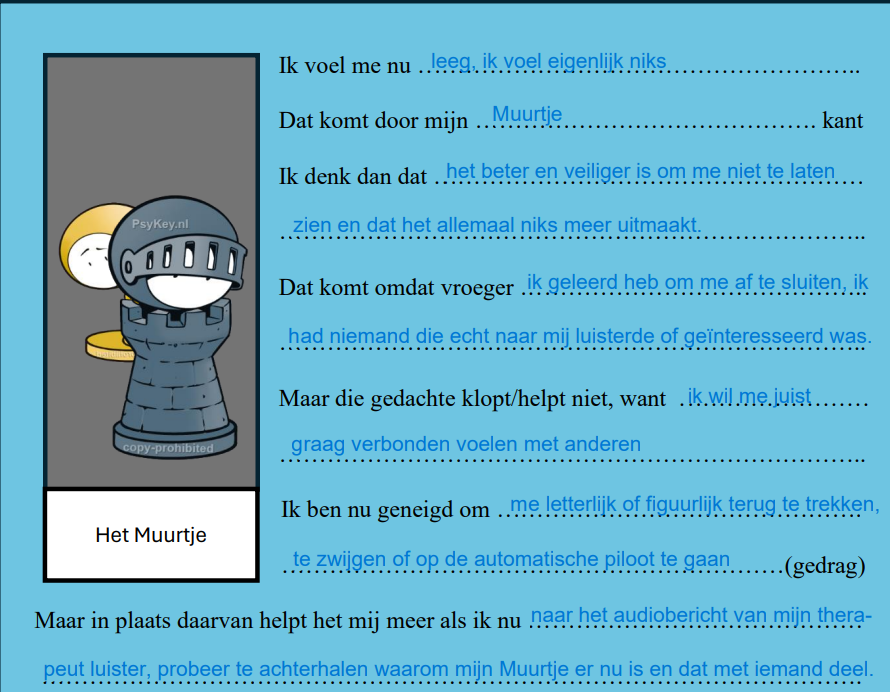
A flashcard can help your client apply the insights gained during a therapy session at home. If desired, you can use the figures from Modes in Focus in this format; see the instructions at the bottom of the format.
Download template of flashcard

FREE DOWNLOAD
Mode sequence
By creating a mode sequence, you can analyse situations with your client. Which modes of your client emerged in this situation and why? And if another person was involved in the situation, which modes of that person interacted with the modes of your client? With the help of the mode sequence, you can create mutual understanding for each other’s perspective and behaviour. Together with your client, you then identiy their underlying emotional needs in such situations. This provides a basis for practising how they can meet their needs in a healthy way!
The format can be used with or without the figures from Modes in Focus. On the first page of the format, you will find instructions on how to insert the figures.

FREE DOWNLOAD
Safety plan
You can incorporate your client’s modes into this early warning signs plan of safety plan. Together with your client, determine which modes occur in which phases (green, orange, red) and how they can recognise them. In the columns next to them, describe what they and others can do to return to their Healthy Adult/Adolescent mode (“green”).
DOWNLOAD TEMPLATE SAFETY PLANFREE DOWNLOAD
Relapse prevention plan
This template helps you create a clear, visual relapse prevention plan. It gives the client tools to deal with (early) signs of relapse after treatment has ended.
Copy the modes from the CC model that are relevant to your client into the relapse prevention plan, and you can get started together with your client!

